Identify developing issues earlier
Review airflow, static pressure, visible restrictions, hopper condition, pulse-system observations, leakage indicators, and other accessible signs of declining performance.
Independent measurement + reporting
Independent dust collector and baghouse inspection for Ontario industrial facilities. Annual and semi-annual programs help plant maintenance teams identify developing restrictions, performance drift, and condition concerns earlier—before minor issues become urgent production problems.
 Want a quick review?
Email a few photos or system details and we’ll point you in the right direction.
Want a quick review?
Email a few photos or system details and we’ll point you in the right direction.
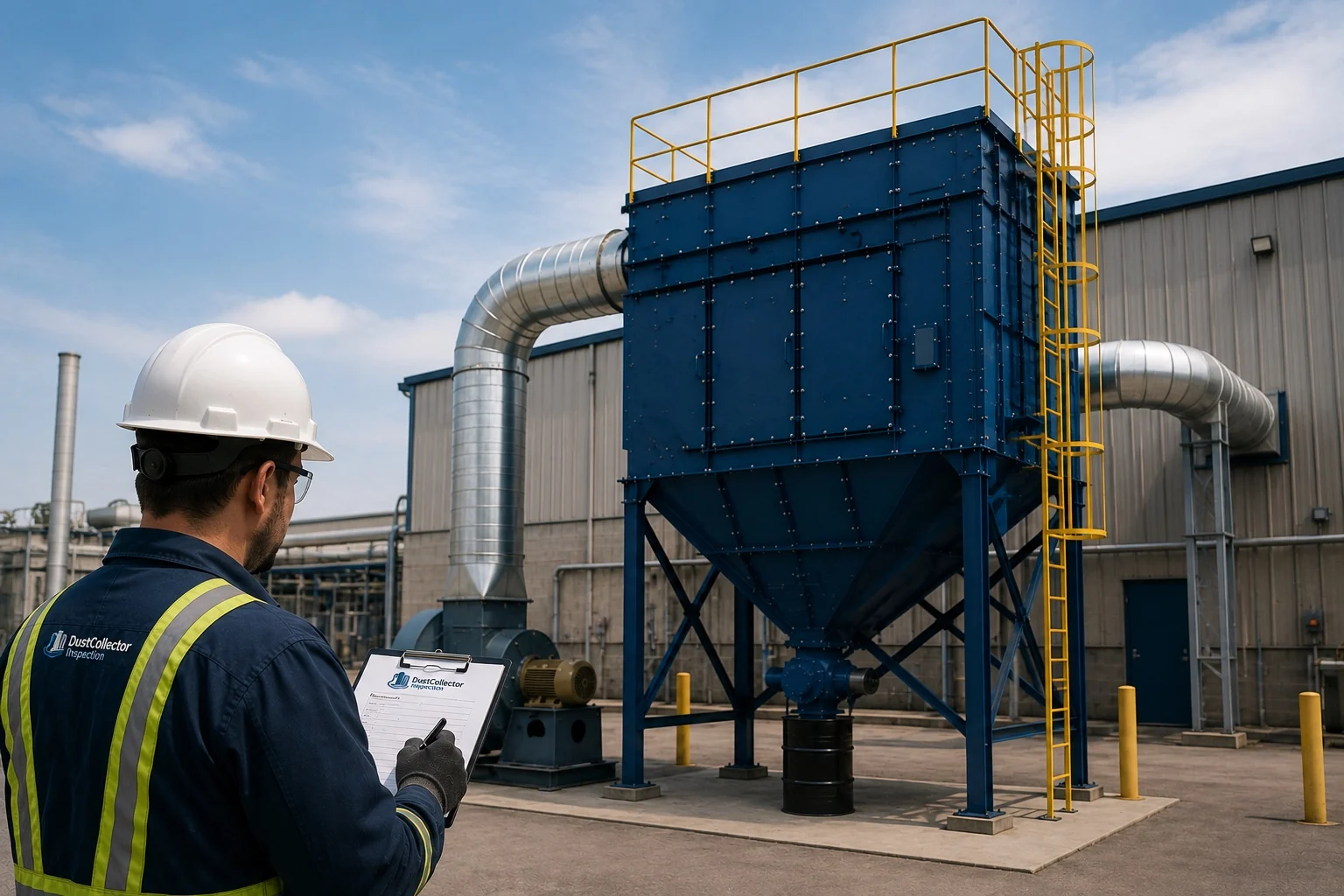
Dust collection problems often develop gradually. A consistent annual or semi-annual review gives plant managers and maintenance teams a documented view of system condition and performance, helping them prioritize corrective work before deterioration contributes to avoidable downtime.

Review airflow, static pressure, visible restrictions, hopper condition, pulse-system observations, leakage indicators, and other accessible signs of declining performance.
Separate urgent concerns from items that can be monitored or budgeted, with concise photo-backed findings and practical recommendations for the plant team.
Compare inspection findings over time, verify whether prior actions were completed, and maintain a consistent record for maintenance, operations, EHS, and management.
The goal is not to promise that every failure can be prevented. It is to reduce uncertainty, identify deterioration sooner, and provide a clearer basis for maintenance planning before dust collection issues become urgent.
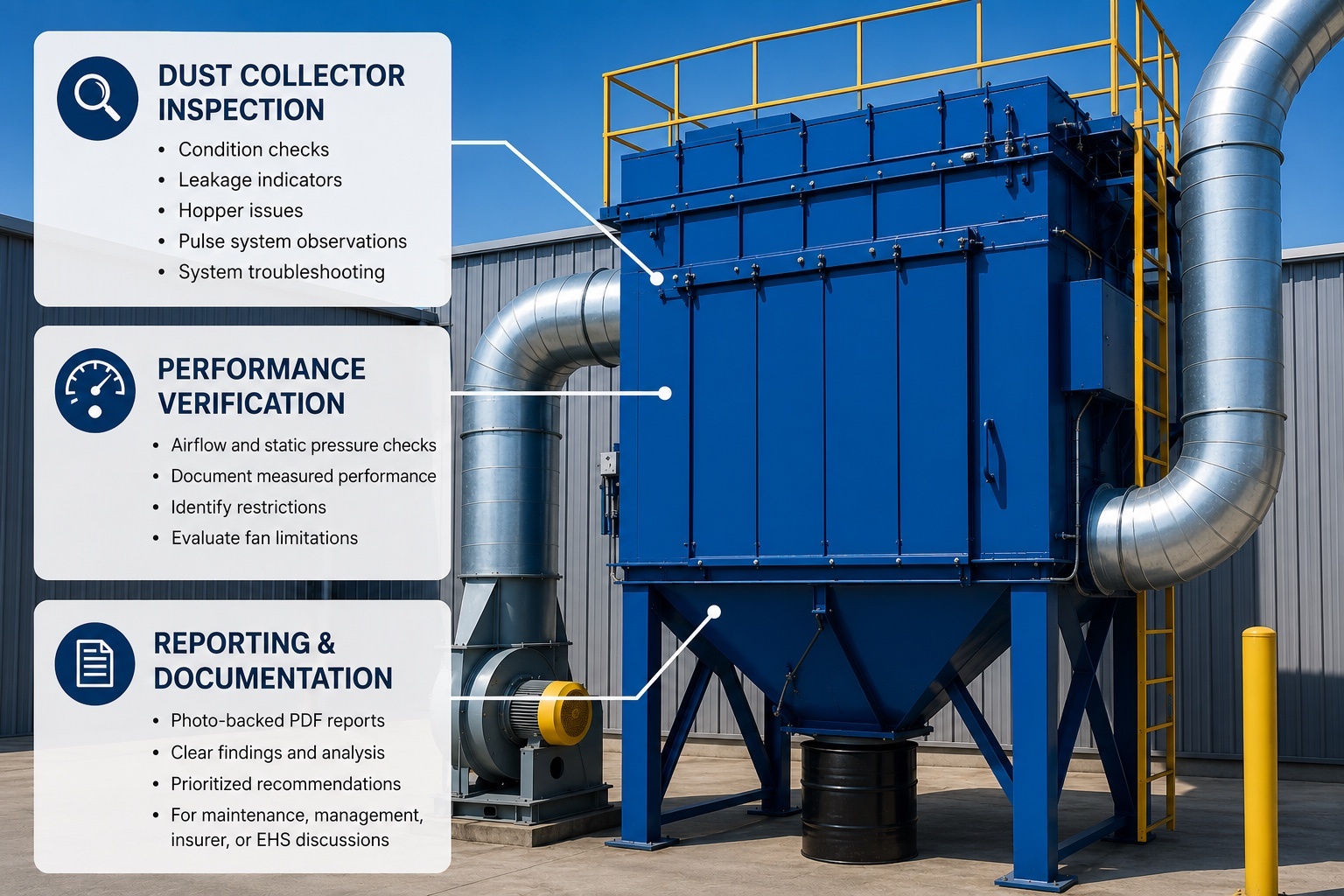
Condition checks, leakage indicators, hopper issues, pulse system observations, and system troubleshooting.
Airflow and static pressure checks to document measured performance and identify restrictions or fan limitations.
Concise, photo-backed PDF reports for maintenance, management, insurer, or EHS discussions.
Need practical support now? See dust collector help in Ontario for common plant problems, troubleshooting, and inspection options.
See the format you’ll receive: a clear PDF with photo documentation and prioritized recommendations.
This example is generalized (no client-identifying information).
Choose a recurring dust collector inspection cadence that fits your production demands, dust loading, equipment criticality, and maintenance resources. Each visit uses a consistent review and reporting approach so changes, unresolved items, and performance drift are easier to track over time.
Best for stable, lower-risk systems
Best balance of oversight, cost, and risk
Best for critical or high-loading processes
Inspection scope depends on access, operating conditions, and site safety requirements. Assumptions and limitations are documented clearly. For help choosing a cadence, see how often dust collectors should be inspected in Ontario plants.
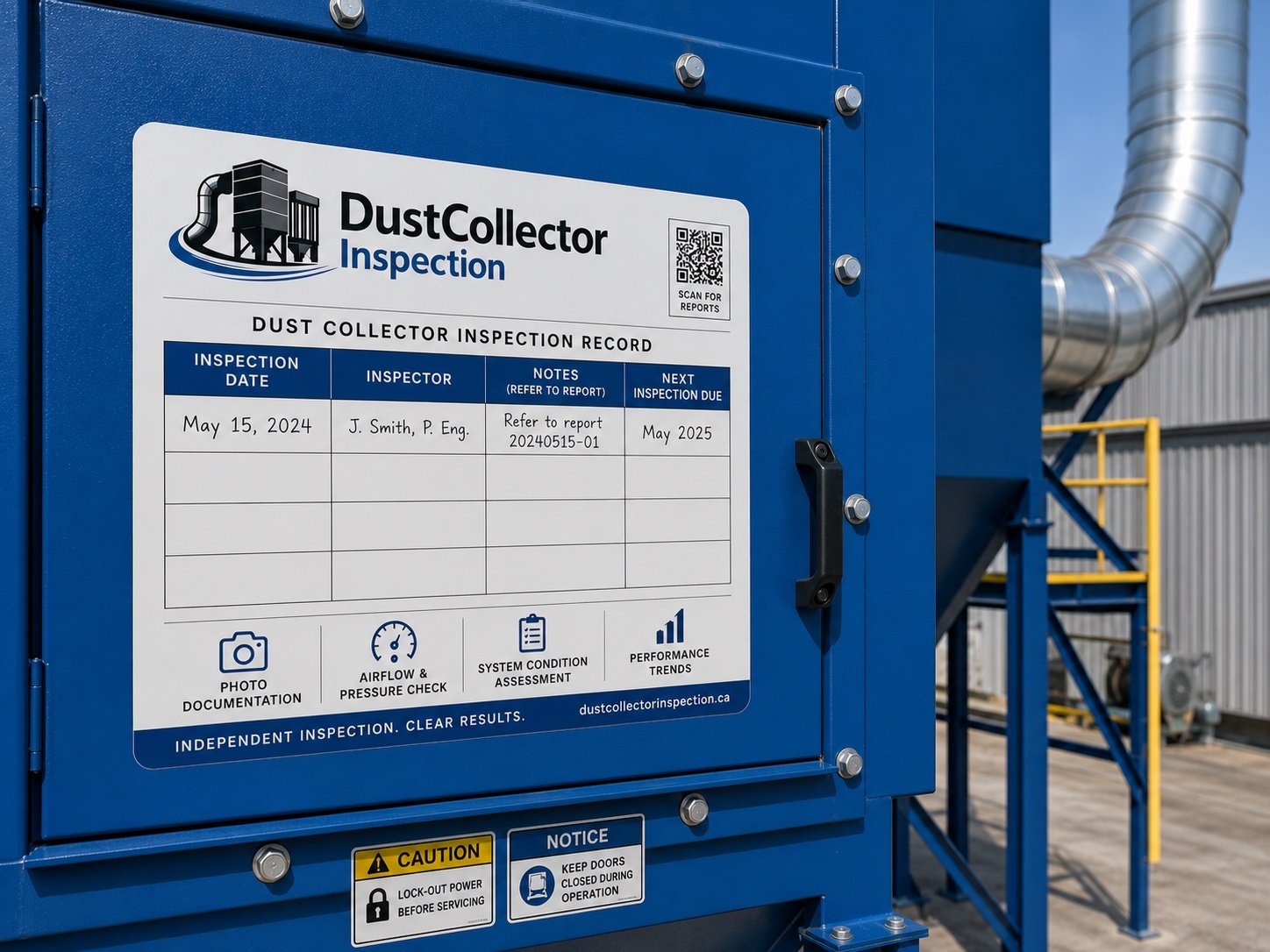
Every inspection includes a durable inspection record applied directly to the dust collector. It provides a visible history of inspections and links each visit to a detailed inspection report.
Instead of searching through old files, anyone can immediately see when the collector was last inspected and reference the corresponding report. Over time, the inspection record creates a documented maintenance history for the equipment.
Facilities across Ontario rely on properly functioning dust collection systems for housekeeping, production performance, maintenance planning, and internal documentation.
Common equipment: cartridge dust collectors, baghouses, cyclones, mist collectors, and multi-branch ducted systems.

Welding fumes • grinding • plasma & laser cutting

Sanding dust • CNC routers • combustible dust awareness

Ingredient dust • bag dumps • conveyors

Elevators • transfer points • grinders

Sand systems • shakeout • high particulate loads

Baghouses • silos • dusty transfer points

Trim dust • pellet handling • mixers

Sorting lines • conveyors • abrasion-heavy systems

Fine powders • containment awareness • filter loading

High-value processes • fine particulate verification
Primary service area is Southwestern Ontario. Travel elsewhere in Ontario and into the United States may be available case-by-case depending on scope and schedule.
Not listed? Email your city — we often travel within the region.
Helpful reads: why dust collectors lose performance over time, inspection frequency for Ontario plants, and dust collector help in Ontario.
We support U.S. sites when it makes sense (multi-site programs, repeat clients, or projects near the border). Feasibility is confirmed during the scope call.
One-time inspections and recurring dust collector inspection programs are quoted after a short scope review. Pricing depends on collector type, number of systems, access conditions, measurement requirements, reporting depth, inspection frequency, and travel.
Most projects can be scoped quickly once we understand the equipment, site location, and what you are trying to verify. A simple single-collector inspection is usually straightforward, while multi-collector facilities, rooftop access, lift requirements, or detailed airflow verification may require a more customized quote.
Annual, semi-annual, and quarterly programs create a consistent inspection history and make it easier to compare condition, measurements, open recommendations, and maintenance actions from one visit to the next.
To quote quickly, send: number of collectors, collector types/models if known, site city, access notes, and your main problem areas. Email info@dustcollectorinspection.ca or use the form below.
We use practical field measurement methods and clearly document assumptions and limitations. We can align reporting with your internal specifications if required.
A recurring program provides a consistent review of accessible system condition, airflow, static pressure, visible restrictions, and prior recommendations. This helps plant maintenance teams identify deterioration earlier, maintain a documented equipment history, and plan corrective work before issues become urgent. It cannot guarantee that every failure or production interruption will be prevented.
No. We do not perform installation work. Optional filter supply is available without commission-driven sales pressure.
Collector model info, drawings (if available), and a short scope call. Most projects begin with a walkdown and verification plan.
Reports are intended for practical dust collector inspection, airflow verification, troubleshooting, and maintenance planning. They are not a substitute for certified TAB reports, engineered system design, Pre-Start Health and Safety Reviews, code compliance reviews, combustible dust hazard analysis, occupational hygiene exposure assessments, or equipment manufacturer inspections where those services are required.