Dust collector inspection
Review accessible filters, seals, leakage indicators, hopper or barrel condition, and pulse-cleaning operation within the agreed scope.
Independent inspections · Ongoing performance history
Establish a documented baseline, then track what improves, what declines, and what needs attention. Independent inspections and recurring reviews give your team a clear history of collector condition, measured performance, and maintenance follow-up.
 Discuss your collector or inspection program
Send a few photos and your facility location to start a scope review.
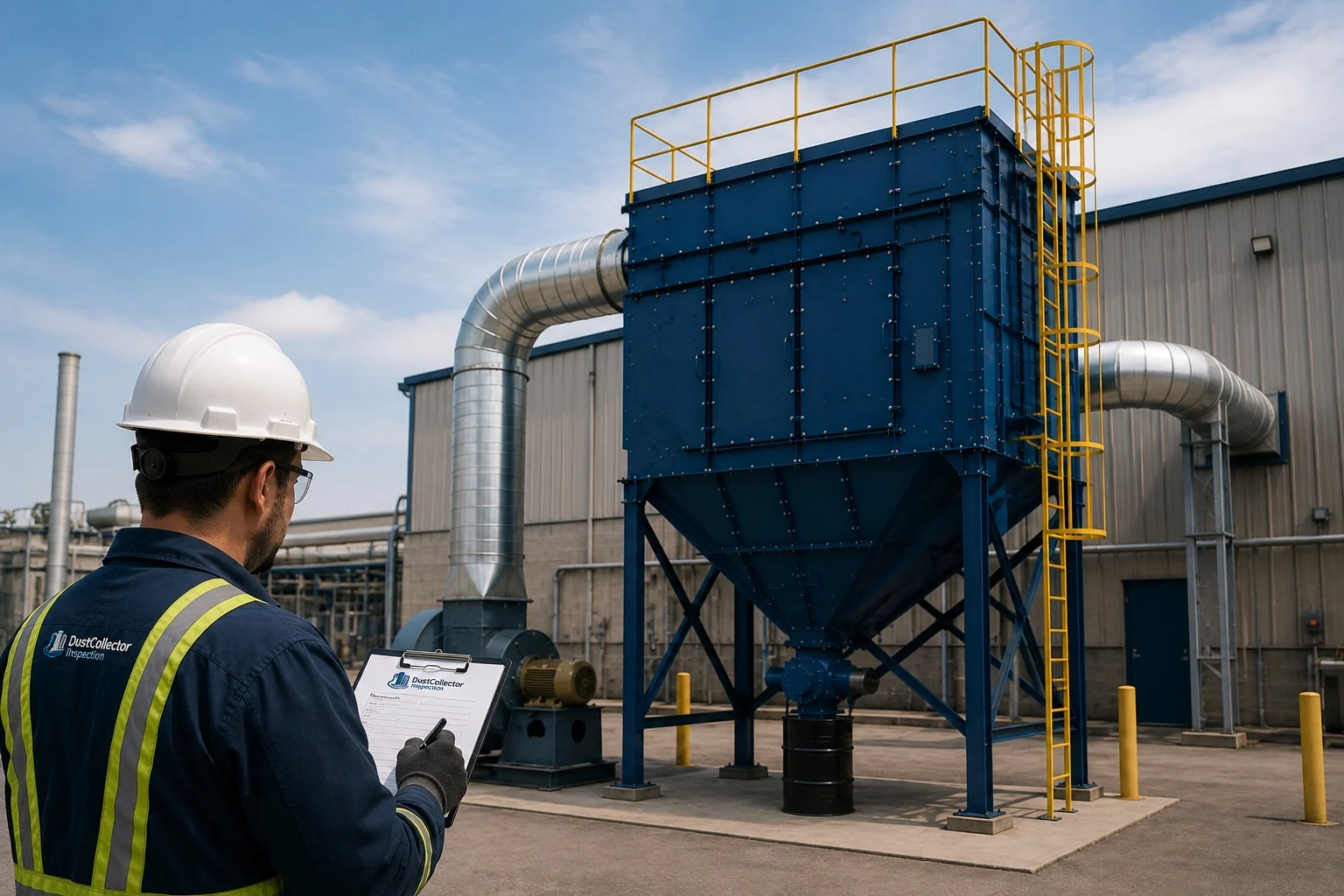
Each visit combines equipment observations, agreed measurements, and a report your team can act on. The first inspection establishes the reference for future reviews.
Review accessible filters, seals, leakage indicators, hopper or barrel condition, and pulse-cleaning operation within the agreed scope.
Record airflow and pressure readings where access allows, along with operating conditions to support meaningful comparisons on future visits.
Receive photographs, selected readings, prioritized recommendations, and a dated record for each collector. Follow-up reports highlight changes and the status of previous actions.
Agree the scope → Inspect and measure → Report findings and priorities
We confirm equipment, access, and operating requirements before the visit. You receive a collector-specific report that becomes the reference for future inspections and maintenance follow-up.
Need practical support now? See dust collector help in Ontario for common plant problems, troubleshooting, and inspection options.
One inspection gives you a snapshot. Repeat inspections show what is changing. Compare condition and readings, follow up on open recommendations, and check the effect of completed maintenance.
Every report builds on the last, giving maintenance and operations a shared record of what changed and what still needs attention.
| Inspection record | Baseline | Six-month review | After maintenance |
|---|---|---|---|
| Airflow | 8,450 CFM | 7,900 CFM | 8,600 CFM |
| Filter differential pressure | 3.2 in. w.g. | 5.1 in. w.g. | 3.0 in. w.g. |
| Maintenance reported by plant | No recent filter change | Filter replacement planned | Filters replaced |
| Previous actions | Baseline established | Work outstanding | Completion reviewed |
Fictional example, not client results. Readings are compared with operating conditions and measurement limitations documented. Maintenance entries reflect plant-provided information, not direct internal inspection; pressure readings alone do not establish filter condition.
Your team can see developing concerns, review completed work, and carry the equipment history forward when responsibilities change.
A yearly review for maintenance planning
A six-month interval for ongoing condition tracking
Closer follow-up for demanding processes
Inspection scope depends on access, operating conditions, and site safety requirements. Assumptions and limitations are documented clearly. For help choosing a cadence, see how often dust collectors should be inspected in Ontario plants.
See the report that starts your collector history: observations, selected readings, photographs, and clear maintenance priorities.
Abridged fictional sample showing findings, photos, and prioritized recommendations. PDF · 3 pages · approximately 325 KB.
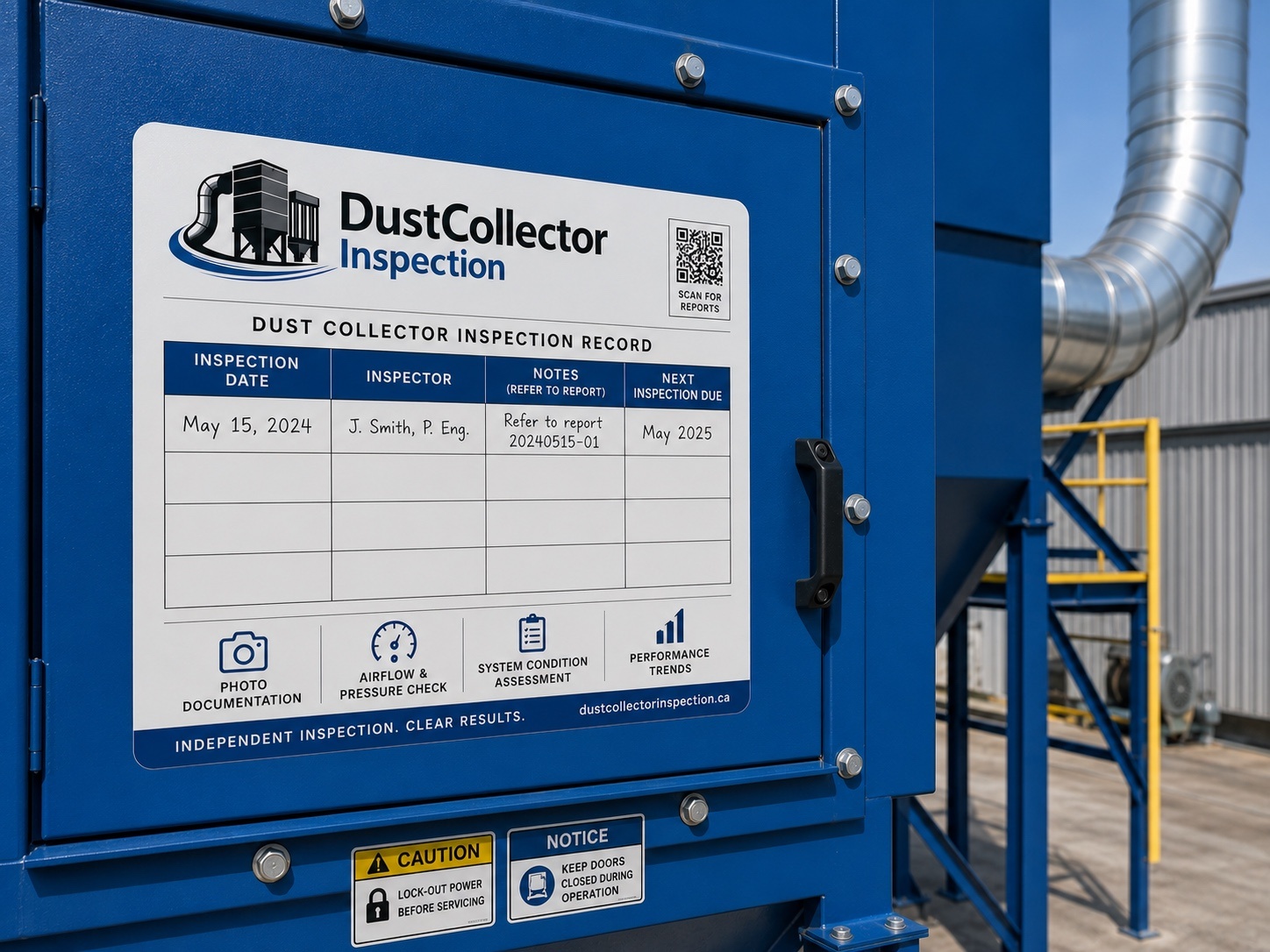
An inspection-history label on the collector connects each visit to its report. Your team can see the latest inspection date and report reference at a glance.
The label connects the equipment to its inspection history; the reports hold the findings, comparisons, and maintenance actions. A label is included when required for the first visit or when the previous label is full.
Facilities across Ontario rely on properly functioning dust collection systems for housekeeping, production performance, maintenance planning, and internal documentation.
Common equipment: cartridge dust collectors, baghouses, cyclones, mist collectors, and multi-branch ducted systems.

Welding fumes • grinding • plasma & laser cutting

Sanding dust • CNC routers • combustible dust awareness

Ingredient dust • bag dumps • conveyors

Elevators • transfer points • grinders

Sand systems • shakeout • high particulate loads

Baghouses • silos • dusty transfer points

Trim dust • pellet handling • mixers

Sorting lines • conveyors • abrasion-heavy systems

Fine powders • containment awareness • filter loading

High-value processes • fine particulate verification
Primary service area is Southwestern Ontario. Travel elsewhere in Ontario and into the United States may be available case-by-case depending on scope and schedule.
Ontario plant support
Serving industrial facilities across Southwestern Ontario, with travel elsewhere reviewed around your equipment, scope, and schedule.
Send your facility city and the number of collectors to confirm availability.
Request a quote for your facilityExplore the region in Google Maps (opens in a new tab)Not listed? Email your city — we often travel within the region.
Helpful reads: why dust collectors lose performance over time, inspection frequency for Ontario plants, and dust collector help in Ontario.
We support U.S. sites when it makes sense (multi-site programs, repeat clients, or projects near the border). Feasibility is confirmed during the scope call.
Baseline inspections and recurring visits are quoted to an agreed scope. Send your facility location, number of collectors, and main concern so we can define the work and deliverables.
Your quote identifies the on-site collector review, travel, and report deliverables. Additional collectors reviewed on the same visit share the travel and mobilization, with their own inspection and reporting scope.
Agree access, operating requirements, and reporting before work begins. For recurring programs, each follow-up reviews changes, previous recommendations, and completed maintenance against the established record.
No. One-time inspections and troubleshooting visits are also available. However, our primary focus is recurring inspection programs, because dust collector condition and performance change over time.
Scheduled visits build a documented history of your equipment, allowing us to compare performance, identify developing concerns, and assess improvements following maintenance. This continuity helps your team plan corrective work and address issues earlier, before they become more disruptive.
We use practical field measurement methods and clearly document assumptions and limitations. We can align reporting with your internal specifications if required.
A recurring program provides a consistent review of accessible system condition, airflow, static pressure, visible restrictions, and prior recommendations. This helps plant maintenance teams identify deterioration earlier, maintain a documented equipment history, and plan corrective work before issues become urgent.
The purpose is to identify observable issues, help prioritize maintenance, and build a consistent record of condition and performance over time. Repeat visits allow us to compare findings and follow up on previous recommendations, providing continuity even when plant personnel change.
Findings reflect the agreed scope, accessible components, and operating conditions at the time of the visit. Hidden defects, intermittent problems, or issues that develop between visits may not be detected. An inspection cannot guarantee that every issue will be identified or that failures will be prevented, and it does not replace routine maintenance or ongoing monitoring by your team.
No. We provide independent inspection and reporting; we do not install dust collection systems. Recommendations reflect observed condition and measured performance. Optional filter supply is available without commission-driven sales pressure.
Collector model info, drawings (if available), and a short scope call. Most projects begin with a walkdown and verification plan.
Reports are intended for practical dust collector inspection, airflow verification, troubleshooting, and maintenance planning. They are not a substitute for certified TAB reports, engineered system design, Pre-Start Health and Safety Reviews, code compliance reviews, combustible dust hazard analysis, occupational hygiene exposure assessments, or equipment manufacturer inspections where those services are required.
Tell us about your collector, a performance concern, or the inspection history you want to establish. We will review the scope with you before quoting.